Last semester I went on a trip with my World Religions class to visit a synagogue, an Islamic center, and a Zen Buddhism center. At the Islamic center we were able to sit down with the Imam (who is kind of like the pastor) and have a discussion. He was a smart guy who had a PhD and taught at (I think) R.I.T. When we sat down to talk with him I thought that he was just going to field some questions of ours, so I was surprised when he actually started to ask us questions.
"What are the three main monotheistic faiths?", He asked us.
We sat quietly. It was one of those questions that are really easy, but no one in the class will answer because it seems way too obvious. Eventually, we all scatteredly said "Christianity, Judaism, and Islam."
"That's correct," he said "now out of those three faiths which one is not purely monotheistic?"
We all knew the answer he wanted. "Christianity" I said, kind of bitterly.
"That's right," he replied "the Christian doctrine of the Trinity separates them from the pure monotheism of Judaism and Islam."
It was a humbling moment.
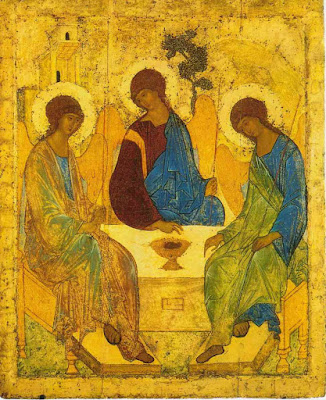
It is true, though. The idea of God as Trinity is one that is completely unique to Christianity. There are a few parts of the Koran that specifically denounce the idea of the Trinity, saying it soils the "oneness" of God. So what do we do with the Trinity? It is such a crazy complicated doctrine that it is easy to ignore. But the truth is that the doctrine of the Trinity has an effect on every other doctrine of the Christian faith. The Trinity is central to our faith. But one of the most important beliefs of our faith is also one of the most controversial. God in three persons. Father, Son, Holy Spirit. What does that mean?
The Trinity is very difficult. Trying to explain it is like walking a tight rope, if you lean too much in any direction you're going to be in trouble. Lean too much one way and you fall into Tri-Theism (three Gods). If you lean too much the other way you fall into modalism (sort of one unknown God wearing "masks" and assuming the roles of Father, Son, and Holy Spirit at different times in history). Every analogy for the Trinity falls short and can be subject to harsh criticism. So what do we do? Just leave it alone? Duh...no.
Like I said, the Trinity has an impact on the rest of Christian doctrine. Without it our Christology would be completely different, and from there on so would our doctrine of justification, sanctification, etc. etc. It would effect our worship. It would effect our very lives. But how?
The Trinity is important to our ideas about what it means to live in community. The Father, Son and Holy Spirit live in perfect union with one another without any subordination or anything like that. They have one purpose and God works perfectly within himself to carry it out. The Trinity is like a tree. The Father is the trunk, the Son is the branches, the Spirit is the leaves. Three parts, but one tree. This analogy falls short in a lot of ways, but its a start into the idea of God. The Trinity gives and sustains life. The Trinity gives love.
So should our communities. The purpose of a Christian community is to work towards one purpose, and that purpose is to spread as much love through the world as possible. It means spreading life and giving life. Like the three persons of the Trinity, we all in the community have different jobs to do. None of them are lower or higher or any more or less importance. Our relationships within the community should be completely loving and respectful. Living in a community means completely giving ourselves to one another. Our communities should reflect the Trinity. This is what it means to live in the light of God. How amazing would a Trinity centered community be? How effective and incredible and world changing would it be?
I know. How idealistic of me.


